
How to Source Tadalafil API From Verified Manufacturers

Every tadalafil API supplier describes itself as verified. Almost none of them say verified by whom, against what record, or on what date. The word has become a marketing adjective rather than a procurement finding.
That matters because a QA reviewer cannot file an adjective. What goes in a supplier qualification record is a set of specific, dated, checkable facts about a named manufacturing site. Building that record is a process, and it runs in a particular order.
This guide sets out that process for buyers qualifying a new tadalafil API source for a regulated market. It is written for sourcing, QA and regulatory teams at pharmaceutical manufacturers, CDMOs, importers and distributors, and it does not provide patient advice or instructions for obtaining prescription medicines.
DIRECT ANSWER
To source tadalafil API from verified manufacturers, confirm the legal manufacturing site against independent public registers rather than supplier paperwork alone. Screen candidates through FDA establishment registration and EDQM records, request a batch-specific Certificate of Analysis, confirm the DMF or CEP support pathway in writing, then qualify a sample before committing to any commercial order.
|
1. Define SPEC AND MARKET |
2. Screen INDEPENDENT RECORDS |
3. Qualify SAMPLE AND COA |
4. Approve AGREEMENT AND REVIEW |
What does “verified” actually mean in tadalafil API sourcing?
Useful verification has one defining property: someone other than the seller can confirm it. Everything else is a claim awaiting corroboration, however professionally it is presented.
Sorting supplier evidence by who can confirm it, rather than by how official it looks, is the fastest way to see what you actually hold.
The four tiers of supplier evidence
| Tier | Evidence type | Who can confirm it |
|---|---|---|
| 1. Independently checkable | FDA drug establishment registration, EDQM CEP records, EudraGMDP entries, WHO prequalification listings | You, directly, from a public register |
| 2. Checkable with cooperation | USDMF number plus a Letter of Authorization, third-party audit reports, regulator inspection outcomes | You, once the holder or auditor releases it |
| 3. Supplier-supplied, needs reconciling | Certificate of Analysis, GMP certificate, SDS, stability summaries, specification sheets | Only by cross-checking against tiers 1 and 2 |
| 4. No evidentiary value | “FDA registration certificates”, marketplace verified badges, ISO 9001 alone, unattributed “GMP approved” claims | Nobody. Treat as absent |
Tier 4 deserves a specific warning. FDA does not issue or recognise “FDA registration certificates,” so a supplier presenting one as proof of approval has told you something meaningful about how it operates. [Source: FDA, Is It Really FDA Approved?]
Stage 1: How do you define the requirement before contacting anyone?
Most bad sourcing outcomes trace back to a vague opening enquiry. If you ask for a price on “tadalafil API,” you will receive quotes that are not comparable to each other and not usable by your regulatory team.
Fix these before the first email goes out:
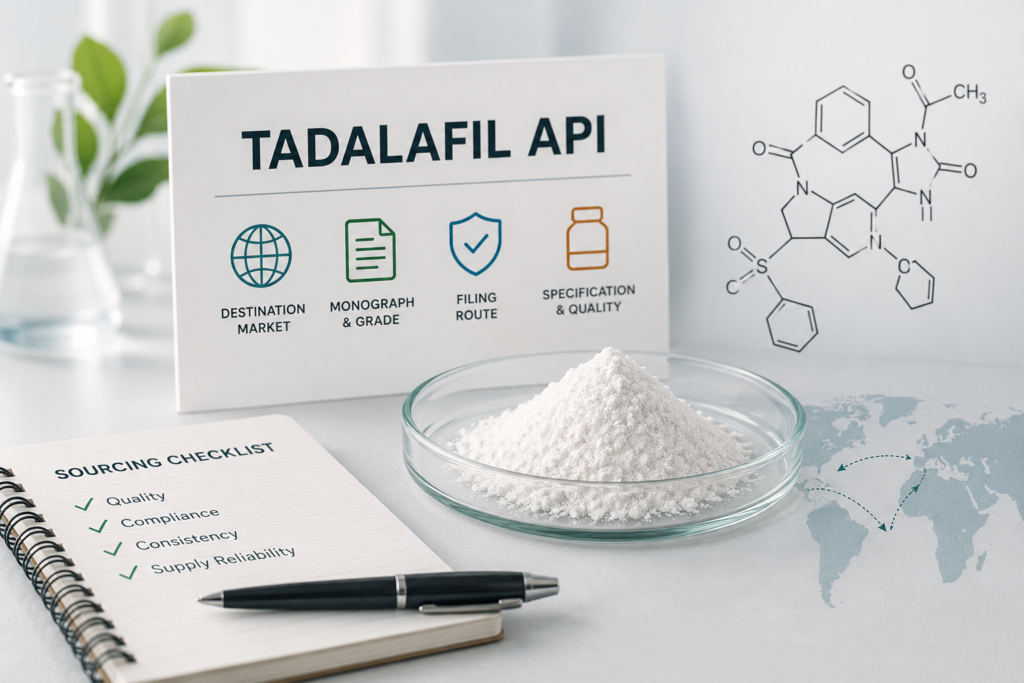
- Destination market. This determines whether you need USDMF support, a CEP, or neither. It is the single most consequential input.
- Monograph and grade. USP, Ph. Eur., BP or an in-house specification, stated explicitly.
- Filing route. An ANDA reference, a market that accepts a CEP, or research and development material each carry different evidence needs.
- Physical specification. Particle size distribution, polymorphic form, residual solvents, water content and microbiological limits where your dosage form requires them.
- Quantity, timeline and packaging. Including whether you need a qualification sample first.
Particle size and polymorphic form deserve emphasis for this molecule. Tadalafil tablets are low-dose solid dosage forms, so particle size drives content uniformity and dissolution, while the polymorphic form affects solubility and physical stability across shelf life. Industry sourcing guidance for tadalafil specifically flags control of stereochemistry, impurity profile and particle size as the parameters that separate capable manufacturers from the rest. [Source: PharmaOffer tadalafil API procurement guidance, accessed August 2026]
Stage 2: Where do you find genuine tadalafil API manufacturers?
Start from regulatory filing data rather than from marketplace listings. A company that has filed a Drug Master File or holds a CEP for tadalafil has, at minimum, committed real cost and disclosure to the molecule.
Practical starting points:
- FDA’s published DMF list, filtered for tadalafil, which gives holder names and filing status
- The EDQM certification database, for CEP holders and their status
- EudraGMDP, for GMP certificates and inspection outcomes at named sites
- Industry filing aggregators, useful for building a longlist quickly, but always reconciled back to the primary register
- Referrals from your own CDMO or a formulator already running a tadalafil programme
Marketplace directories are legitimate discovery tools, and they cover far more suppliers than the filing registers do. The discipline is simply to treat a directory listing as a lead rather than as a finding, and to move every serious candidate up into tier 1 evidence before you spend time on them.
Stage 3: How do you screen a manufacturer’s claims against independent records?
This is the step most buyers skip, and it takes under an hour per candidate.
The screening sequence
- Get the site address, not the office address. Ask for the legal manufacturer name and the physical manufacturing site for tadalafil specifically. A company can run several sites and make this molecule at only one.
- Check that site against the register. Foreign establishments supplying the US must be registered with FDA and must list their known importers. [Source: 21 CFR Part 207]
- Confirm the filing belongs to that site. A DMF held by a parent entity for a different site does not support the material you are being quoted.
- Ask for the Letter of Authorization process in writing. Not the DMF number. The process.
- Reconcile names across documents. The manufacturer on the COA, the site on the GMP certificate, the invoicing party and the bank beneficiary should form a coherent picture. Unexplained divergence is the finding.
- Establish who releases the batch. Manufacturing and quality release are sometimes separate parties, and you need to know which one is answering your questions.
FDA’s Q7 guidance frames the scope you are checking against: the API manufacturing chain from receipt of materials through production, packaging, labelling, quality control, release, storage and distribution. A verification that stops at one certificate has not covered that chain. [Source: FDA guidance for industry, ICH Q7 Good Manufacturing Practice Guidance for Active Pharmaceutical Ingredients]
Is a DMF actually required to import tadalafil API?
This is commonly overstated, so it is worth being precise. A Drug Master File is not itself a legal precondition for importing an API. It is a confidential submission that allows a drug applicant to reference a facility’s information without that information being disclosed, and FDA neither approves nor disapproves DMFs. [Source: FDA guidance for industry, Drug Master Files]
What is true is narrower and more useful: if your API supports an ANDA or NDA, you will in practice need an active USDMF from that site plus a Letter of Authorization to reference it. If you are sourcing for research and development, or for a market that works through a CEP, the requirement is different. Establish which situation you are in before you let a supplier tell you what is mandatory.
Stage 4: What should the qualification sample prove?
A sample is not a formality and it is not a taste test. It is the point at which paperwork becomes checkable against material.
Insist on the following, and treat resistance to any of it as informative:
- A batch-specific COA, not a representative one. It should carry the batch number, test methods, acceptance criteria and actual results, and the batch number should match the sample container.
- Independent confirmatory testing. Run identity, assay and related substances in your own or a contract laboratory. Compare your results against the supplied COA, not just against the specification.
- Sample chain of custody. Where the sample was drawn, by whom, and from which container.
- Batch age and retest date. An unusually low price often reflects an aged batch with a short remaining window rather than a competitive cost base.
- Packaging as it will actually ship. Commonly 25 kg HDPE drums with double LDPE liners, though this varies by site.
A COA that reports results identical to the specification limits, or suspiciously round numbers across every parameter, warrants a second look. Real analytical data has scatter.
When does an on-site audit become necessary?
For commercial supply into a regulated market, an audit is generally expected rather than optional. The practical question is which form of audit is proportionate.
| Approach | Typically suits | Main limitation |
|---|---|---|
| Paper or desktop audit | Initial screening, R and D quantities, low-risk repeat supply | Confirms documents exist, not that practice matches them |
| Shared third-party audit report | Buyers without an internal audit function, or a second source | Scope was set by someone else and may not cover your product |
| Your own on-site audit | Primary commercial source for a filed product | Cost and lead time, and access has to be negotiated |
Whichever route you take, the audit should cover the tadalafil production line specifically. A GMP finding at a site that makes a dozen molecules does not automatically extend to the one you are buying.
How do you keep a verified supplier verified?
Verification has a shelf life. Sites change ownership, filings lapse, processes get revised and inspection outcomes change. A qualification file dated three years ago describes a supplier that may no longer exist in that form.
- Put a change notification clause in the quality agreement. The supplier should be contractually obliged to tell you before changing the site, the synthetic route, key raw material sources or the specification.
- Set a re-qualification interval and hold to it, with an out-of-cycle trigger if an inspection outcome or filing status changes.
- Trend incoming batch data rather than checking each batch in isolation. A slow drift in an impurity profile is the signal a pass or fail check will miss.
- Qualify a second source before you need one. The moment you need it is the moment you have no leverage and no time.
What US-specific checks apply to tadalafil API?
- Establishment registration. The foreign manufacturing site must be registered with FDA and must list its known importers. [Source: 21 CFR Part 207]
- USDMF and LOA, where you are filing. Required in practice to reference the site’s information in an ANDA or NDA. [Source: FDA guidance for industry, Drug Master Files]
- DSCSA does not apply to bulk API. Package-level transaction tracing covers finished dosage products in the pharmacy distribution chain, not drug substance. Do not accept serialisation as an API quality credential. [Source: FDA, Drug Supply Chain Security Act]
- Compounding buyers. Outsourcing facilities and 503A pharmacies must confirm the substance’s standing under the applicable bulk drug substances provisions before compounding with it. [Source: FDCA sections 503A and 503B]
- Patent and exclusivity. A separate check from quality. Confirm the current position for your product, strength and indication in the FDA Orange Book rather than relying on a supplier’s assurance. [Source: FDA Orange Book]
WHO-GMP certification from CDSCO, EU-GMP, or a CEP are all meaningful in their own frameworks. None substitutes for the US requirements above. A site can hold WHO-GMP certification and still have no FDA registration and no active USDMF.
What clinical facts should your regulatory file reflect?
Tadalafil is a selective PDE5 inhibitor. In the United States, approved labelling covers erectile dysfunction, the signs and symptoms of benign prostatic hyperplasia, ED and BPH occurring together, and pulmonary arterial hypertension to improve exercise ability. Any other proposed use is off-label and would require your own regulatory justification. [Source: FDA prescribing information, CIALIS and ADCIRCA]
Tadalafil has a terminal half-life of roughly 17.5 hours, and it is metabolised predominantly by CYP3A4, so exposure can increase with strong CYP3A4 inhibitors. Both facts shape labelling and interaction sections in the finished product dossier. [Source: FDA prescribing information, CIALIS, Clinical Pharmacology and Drug Interactions sections]

Who should not take tadalafil: contraindications
- Anyone using any form of organic nitrate, regularly or intermittently. Tadalafil potentiates the hypotensive effect of nitrates and co-administration is contraindicated.
- Anyone using a guanylate cyclase stimulator such as riociguat, because of potentiated hypotensive effects.
- Anyone with known serious hypersensitivity to tadalafil. Reactions including Stevens-Johnson syndrome and exfoliative dermatitis have been reported.
- Anyone for whom sexual activity is inadvisable on cardiovascular grounds.
Use with caution: with alpha-blockers, other antihypertensives, or substantial alcohol (5 units or more), any of which may lead to hypotension. Combination with alpha-blockers is not recommended for BPH treatment. Caution also applies where a patient is predisposed to priapism, for example sickle cell anaemia, multiple myeloma or leukaemia, or has anatomical deformation of the penis.
Emergency nitrate use: where nitrate administration is judged medically necessary in a life-threatening situation, labelling advises at least 48 hours should elapse after the last tadalafil dose, and then only under close medical supervision with haemodynamic monitoring.
[Source: FDA prescribing information, CIALIS (tadalafil) tablets, Contraindications, Warnings and Precautions, and Drug Interactions sections]
Common adverse reactions
The reactions reported most frequently in clinical trials include headache, dyspepsia, back pain, myalgia, nasal congestion, flushing and pain in the limb. Less common but clinically significant events described in labelling include prolonged erection and priapism, sudden decrease or loss of vision (reported in association with non-arteritic anterior ischaemic optic neuropathy), and sudden decrease or loss of hearing. US labelling for tadalafil does not carry a boxed warning, which should not be read as an absence of risk. [Source: FDA prescribing information, CIALIS, Adverse Reactions section]
Which counterfeit and diversion signals should you watch for?
Tadalafil is among the substances most frequently found undeclared in “natural” or herbal sexual enhancement products sold online, and FDA has issued repeated public notifications about tainted products in that category. [Source: FDA, Tainted Sexual Enhancement Products public notifications]
Claims of “natural tadalafil” are not supportable. Tadalafil is a synthetic small molecule and a prescription drug, so a supplement containing it is adulterated, and the consumer has no way of knowing they are taking something contraindicated with nitrates.
For a legitimate buyer this cuts two ways. Expect KYC scrutiny from serious suppliers about your manufacturing authorisation and intended use, because a supplier that does not ask you is not asking anyone. And keep documented chain of custody from the manufacturing site through to goods-in, since that record is what distinguishes your supply chain from the diversion channel if either is examined.
Stop the qualification process if you see any of these
- A DMF or CEP is claimed but the holder identity or LOA process cannot be produced.
- An “FDA registration certificate” is offered as proof of approval.
- The named manufacturing site shifts between the COA, the GMP certificate and the invoice.
- The bank beneficiary does not match the contracting party, and the change is not independently verified.
- Payment is pressed for before sample review or document reconciliation.
- Site access is refused for a primary commercial source without a coherent explanation.
The beneficiary mismatch deserves particular attention. Payment redirection fraud against pharmaceutical buyers usually arrives as a plausible mid-transaction banking update, and losses are rarely recoverable. Verify any change through a channel you already had, never one supplied in the message requesting the change.
When to see a doctor
This page is written for commercial and regulatory readers. If you are a patient or caregiver who has arrived here, seek prompt medical attention for any of the following while taking tadalafil:
- Chest pain or anginal symptoms, which require immediate medical attention
- An erection lasting longer than four hours
- Sudden loss or decrease of vision, in one or both eyes
- Sudden loss or decrease of hearing, with or without tinnitus or dizziness
- Signs of a serious skin reaction, such as blistering or peeling
[Source: FDA prescribing information, CIALIS, Patient Counseling Information]
Frequently asked questions
How do I know if a tadalafil API manufacturer is legitimate?
Confirm the specific manufacturing site against an independent public register rather than relying on documents the supplier sends you. For US supply, the establishment must be registered with FDA and list its known importers. Then check that any DMF or CEP claimed belongs to that same site, and that the manufacturer named on the COA matches the GMP certificate and the invoicing party. [Source: 21 CFR Part 207]
Is a DMF required to import tadalafil API into the US?
Not as a standalone legal precondition. A DMF is a confidential submission that lets a drug applicant reference a facility’s information, and FDA neither approves nor disapproves DMFs. In practice, if the API supports an ANDA or NDA, you will need an active USDMF from that site plus a Letter of Authorization to reference it. Research quantities and CEP-based markets follow different requirements. [Source: FDA guidance for industry, Drug Master Files]
Why is tadalafil contraindicated with nitrates?
Both act on the same vasodilatory pathway, and the combination can produce a severe drop in blood pressure. US labelling contraindicates tadalafil with any form of organic nitrate. Because of the roughly 17.5 hour half-life, labelling advises at least 48 hours between the last tadalafil dose and any medically necessary nitrate administration, under close supervision. [Source: FDA prescribing information, CIALIS]
What is the difference between a GMP certificate and a CEP?
A GMP certificate reflects a regulator’s finding about how a site operates. A CEP is an EDQM certificate indicating that the relevant European Pharmacopoeia monograph is suitable for controlling that specific substance from that holder under certified conditions. One is about the facility, the other about the substance, and neither implies the other. [Source: EDQM certification background and legal framework]
Can an individual buy tadalafil API?
No. Tadalafil is a prescription-only medicine and bulk API is supplied only to licensed manufacturers, CDMOs, importers, distributors and research institutions with a lawful purpose in the destination market. Bulk drug substance is not a consumer product and is not suitable for self-administration in any form.
How long does supplier qualification usually take?
It varies with the destination market and whether an on-site audit is required. Document screening can be done in days, sample qualification typically runs on your laboratory’s turnaround, and an audit adds scheduling and travel lead time. Build the timeline backwards from your filing or launch date rather than starting the process when material is already needed.
Are “natural tadalafil” supplements a legitimate alternative?
No. Tadalafil is a synthetic prescription drug, so no supplement contains a natural form of it. Products in this category that do contain tadalafil contain it as an undeclared adulterant, which FDA has flagged repeatedly through public notifications on tainted sexual enhancement products. [Source: FDA, Tainted Sexual Enhancement Products public notifications]
Bringing it together
Verification is not a badge a supplier holds. It is a file you build, made of dated facts that someone other than the seller can confirm, about one named manufacturing site and one named material.
Define the requirement, screen against independent records, qualify a real sample against a batch-specific COA, then approve under a quality agreement with a re-qualification date already in the calendar. Suppliers that welcome that sequence are usually the ones worth buying from.
Disclaimer. This article is for informational purposes only and is not a substitute for professional medical advice. Consult your doctor before starting, stopping, or changing any medication.
References
- US Food and Drug Administration. CIALIS (tadalafil) tablets, full prescribing information. Drugs@FDA.
- US Food and Drug Administration. ADCIRCA (tadalafil) tablets, full prescribing information. Drugs@FDA.
- US Food and Drug Administration. Guidance for Industry: Drug Master Files.
- US Food and Drug Administration. Guidance for Industry: Q7 Good Manufacturing Practice Guidance for Active Pharmaceutical Ingredients.
- US Food and Drug Administration. 21 CFR Part 207, Requirements for Foreign and Domestic Establishment Registration and Listing.
- US Food and Drug Administration. Drug Supply Chain Security Act (DSCSA) programme materials.
- US Food and Drug Administration. Tainted Sexual Enhancement Products, public notifications.
- US Food and Drug Administration. Orange Book: Approved Drug Products with Therapeutic Equivalence Evaluations.
- European Directorate for the Quality of Medicines and HealthCare. Certification of Suitability, background and legal framework.
- American Urological Association. Erectile Dysfunction: AUA Guideline.