
Side Effects Of Tadalafil: What You Should Know
Side effects of tadalafil are usually mild and predictable, but “long-term,” “on the heart,” and “20 mg” are three of the most common follow-up questions people have. This guide covers what actually shows up in clinical trial data, including the longer-term studies that go beyond a typical few-week trial.
|
Quick Answer The most common tadalafil side effects are headache, dyspepsia, back pain, muscle aches, flushing, and nasal congestion, which are dose-dependent and generally mild to moderate. Long-term studies of up to 24 months found tadalafil well tolerated, with pooled cardiovascular safety data showing no increased risk of heart attack or major cardiac events compared with placebo. Serious side effects are rare but require urgent medical attention. [Source: FDA Tadalafil Prescribing Information; Porst et al., long-term safety study, 2008] |
Most Common Side Effects of Tadalafil
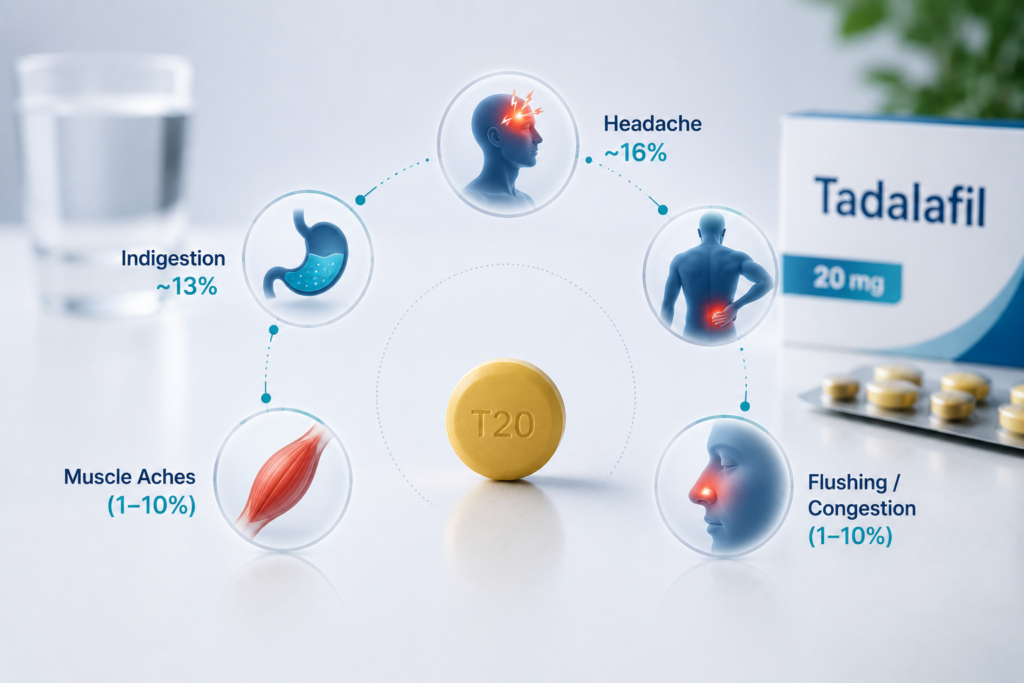
In pooled analyses of clinical trials, the most frequently reported side effects were dose-dependent, transient, and generally mild or moderate. [Source: FDA Tadalafil Prescribing Information]
| Side Effect | Reported Frequency |
| Headache | Up to ~16% [Source: Porst et al., 2008] |
| Dyspepsia (indigestion) | Up to 13% [Source: Drugs.com Tadalafil Side Effects, citing FDA data] |
| Back pain | Around 8% [Source: Porst et al., 2008] |
| Muscle aches | Common (1-10%) [Source: FDA Tadalafil Prescribing Information] |
| Flushing, nasal congestion | Common (1-10%) [Source: FDA Tadalafil Prescribing Information] |
Why Do These Side Effects Happen?
Most common side effects trace back to tadalafil’s core mechanism: PDE5 inhibition causes vasodilation, or widening of blood vessels, throughout the body, not just in genital tissue. That’s what produces headache, flushing, and congestion. Back pain and muscle aches tend to appear 12-24 hours after a dose and typically resolve within about 48 hours. [Source: clinicaltrials.gov protocol documentation, tadalafil safety data]
Tadalafil 20 mg Side Effects vs. Lower Doses
Side effects are dose-dependent, meaning the 20 mg as-needed dose is more likely to produce noticeable effects than the 2.5 mg or 5 mg once-daily doses. This doesn’t mean 20 mg is unsafe when prescribed appropriately, only that dose and side-effect likelihood move together. [Source: FDA Tadalafil Prescribing Information]
Tadalafil Side Effects on the Heart
A cardiovascular safety review analyzing data from more than 4,000 subjects across over 60 clinical studies found that tadalafil produced only small, not clinically relevant, blood pressure changes in healthy subjects, including with daily 20 mg dosing over 26 weeks. [Source: Kloner et al., American Journal of Cardiology, 2003]
In that same analysis, the incidence rate of myocardial infarction among tadalafil-treated patients was 0.43 per 100 patient-years, compared with 0.6 per 100 patient-years in the placebo group, and comparable to the expected rate in an age-standardized male population. [Source: Kloner et al., American Journal of Cardiology, 2003]
A separate pooled analysis of severe adverse cardiovascular events across placebo-controlled trials found these events were rare and occurred at similar rates in tadalafil users and placebo users. [Source: Kloner, cardiovascular safety review, 2007]
Postmarketing reports have noted cases of myocardial infarction, stroke, and sudden cardiac death occurring in temporal association with tadalafil use, most commonly in patients with pre-existing cardiovascular risk factors and often during or shortly after sexual activity itself, which carries its own cardiac demand. [Source: FDA Tadalafil Prescribing Information]
| Important: The one clear cardiovascular danger is not general heart risk but the nitrate interaction specifically: combining tadalafil with any nitrate can cause a severe, life-threatening drop in blood pressure and is contraindicated. [Source: FDA Tadalafil Prescribing Information] |
Long-Term Side Effects of Tadalafil
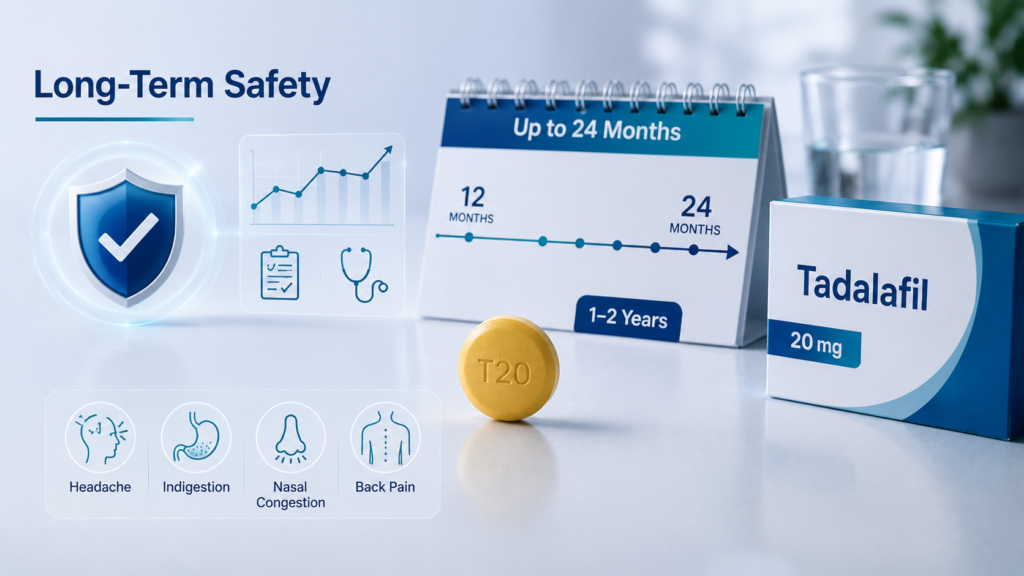
A 24-month, open-label extension trial of 1,173 men found tadalafil safe and well tolerated over that period, with headache (15.8%), dyspepsia (11.8%), nasopharyngitis (11.4%), and back pain (8.2%) as the most common treatment-emergent adverse events. Discontinuation due to adverse events occurred in 6.3% of patients, with no single side effect responsible for more than 1% of discontinuations. [Source: Porst et al., long-term safety and tolerability study, 2008]
A separate long-term study of the 5 mg once-daily dose over 1-2 years reported similar tolerability, describing tadalafil as a viable option for extended daily use in men with ED. [Source: McMahon, long-term safety and efficacy of tadalafil 5 mg once daily, 2008]
It’s worth noting that most published long-term data extends to about 18-24 months; research beyond that window is more limited, so “long-term” in the current evidence base generally means up to two years rather than decades. [Source: long-term tadalafil safety review]
Rare but Serious Side Effects
|
Seek Urgent Medical Attention For An erection lasting longer than 4 hours (priapism), which can cause permanent damage if untreated. [Source: FDA Tadalafil Prescribing Information] Sudden decrease or loss of vision, which may indicate non-arteritic anterior ischemic optic neuropathy (NAION), a rare but reported event with PDE5 inhibitors. [Source: FDA Tadalafil Prescribing Information] Sudden decrease or loss of hearing, sometimes with ringing in the ears or dizziness. [Source: FDA Tadalafil Prescribing Information] |
Who Should Not Take Tadalafil
|
Contraindications and Cautions Contraindicated with organic nitrates and guanylate cyclase stimulators such as riociguat. [Source: FDA Tadalafil Prescribing Information] Use caution with alpha-blockers, other antihypertensives, and unstable cardiovascular disease, including recent heart attack, unstable angina, or uncontrolled heart failure. Anyone with priapism-predisposing conditions or a history of sudden vision or hearing loss on a PDE5 inhibitor should discuss risk with a prescriber first. |
How Long Do Tadalafil Side Effects Last?
Common side effects like headache and flushing are typically transient, resolving within hours. Back pain and muscle aches can appear a day after dosing and generally clear within about 48 hours. Because tadalafil has a long half-life (~17.5 hours), effects, including side effects, can persist longer than with shorter-acting PDE5 inhibitors. [Source: FDA Tadalafil Prescribing Information]
Warning Signs of an Unverified Tadalafil Product
| Sold without a prescription requirement |
| Marketed as “natural tadalafil” or a side-effect-free alternative |
| Unusually severe or unfamiliar side effects that don’t match known tadalafil safety data, which can signal a counterfeit or mis-dosed product |
When Should You See a Doctor?
| Side effects are severe, persistent, or worsening |
| You have cardiovascular disease or risk factors and are considering starting tadalafil |
| You take nitrates, alpha-blockers, or multiple blood-pressure medications |
| You experience an erection lasting more than 4 hours, or sudden vision or hearing changes |
Frequently Asked Questions
What are the most common side effects of tadalafil?
Headache, dyspepsia, back pain, muscle aches, flushing, and nasal congestion are the most frequently reported side effects.
Are tadalafil side effects long-term?
Most side effects are short-lived per dose. Extension trials of 18-24 months found tadalafil generally well tolerated over that period, with a low discontinuation rate due to adverse events.
Is tadalafil 20 mg safe for the heart?
Pooled cardiovascular safety data has not shown increased risk of heart attack or major cardiac events with tadalafil compared to placebo, though anyone with cardiovascular disease should be evaluated by a prescriber before starting any dose.
Do tadalafil side effects go away?
Yes, most common side effects like headache and flushing resolve within hours, and back pain or muscle aches typically clear within about 48 hours.
Can tadalafil cause a heart attack?
Clinical data has not shown an increased rate of heart attack with tadalafil compared to placebo. The clear cardiac danger is combining it with nitrates, which is contraindicated due to the risk of severe hypotension.
|
The Bottom Line Tadalafil’s common side effects are generally mild, dose-dependent, and transient. Long-term studies extending to 18-24 months, along with pooled cardiovascular safety analyses, have not shown an increased risk of major heart events compared to placebo. The clearest serious risk remains the nitrate interaction, along with rare events like priapism and sudden vision or hearing loss that need immediate attention. A prescriber can weigh individual cardiovascular history before starting. |
This article is for informational purposes only and is not a substitute for professional medical advice. Consult your doctor before starting, stopping, or changing any medication.
|
References and Sources FDA. Tadalafil (Cialis/Adcirca) Prescribing Information. Kloner RA, et al. Cardiovascular Effects of Tadalafil. American Journal of Cardiology, 2003. Kloner RA. The Cardiovascular Safety of Tadalafil. 2007. Porst H, et al. Long-Term Safety and Tolerability of Tadalafil in the Treatment of Erectile Dysfunction. 2008. McMahon C. Long-Term Safety and Efficacy of Tadalafil 5 mg Dosed Once Daily. 2008. |