
How to Verify a Tadalafil API Manufacturer in India
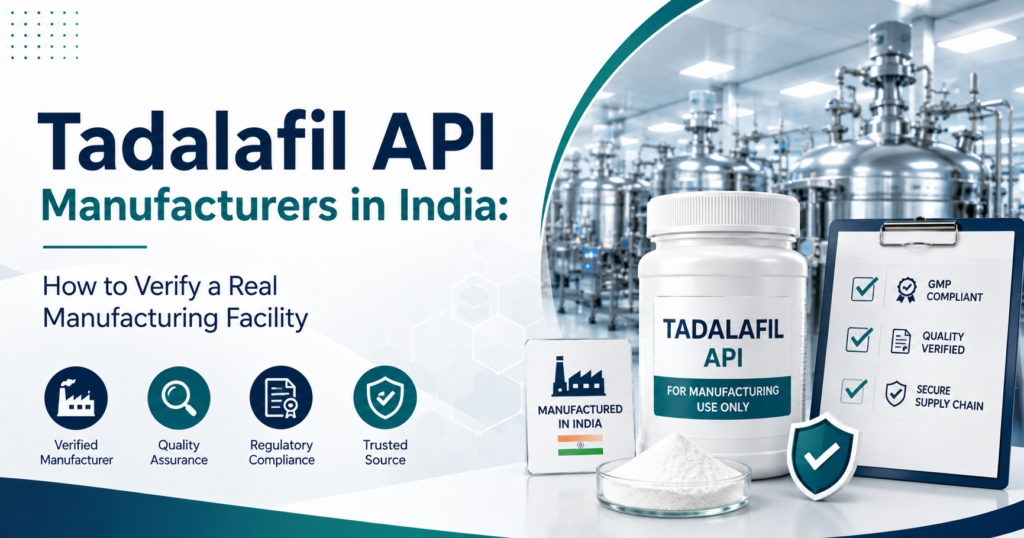
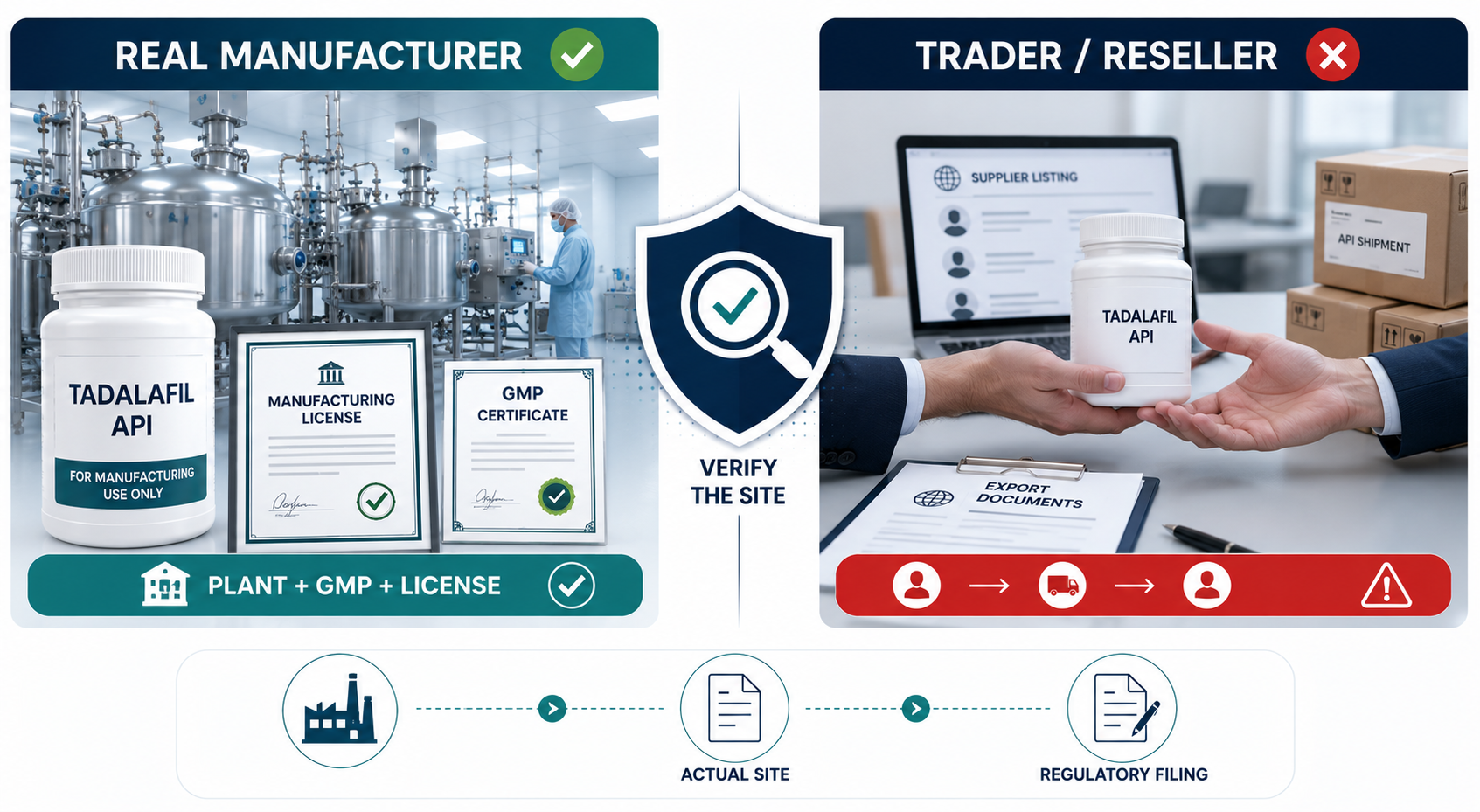
Not every company calling itself a “Tadalafil API manufacturer in India” actually manufactures anything. Some are traders reselling material from a plant they never name, repackaged under their own label. For a US pharmaceutical buyer, that distinction can affect your own regulatory filing, not just your price per kilogram. This guide covers what separates a genuine manufacturer from a trader, and what to ask for before you commit to an order.
|
In short: Many companies listed as “Tadalafil API manufacturers in India” are actually traders or repackagers sourcing from a third-party plant. A genuine manufacturer can show backward integration or a clearly documented supply chain, a valid GMP certificate tied to the actual production site, batch manufacturing records, and an FDA inspection history you can check independently. Tadalafil itself is a prescription-only PDE5 inhibitor (Cialis, Adcirca); API sourcing is a regulated B2B activity, not a consumer purchase. |
What Counts as an Actual Manufacturer (Not Just a Listing)
In pharmaceutical trade, “manufacturer” is a specific regulatory role: the entity that actually operates the plant, controls the synthesis or final processing steps, and holds the manufacturing license and GMP certificate for that site. Many directory listings use “manufacturer” loosely to describe traders, exporters, or aggregators who resell API produced elsewhere.
For Tadalafil (CAS 171596-29-5, PDE5 inhibitor, the active ingredient in Cialis and Adcirca), this distinction matters because your own regulatory filing (such as an ANDA in the US) needs to reference the actual manufacturing site, not an intermediary. [Source: FDA guidance on Drug Master Files and ANDA referencing]
On-Label Use, for Regulatory Context
Tadalafil’s FDA-approved indications are erectile dysfunction (ED), benign prostatic hyperplasia (BPH), and pulmonary arterial hypertension (PAH), marketed as Cialis and Adcirca. [Source: FDA label, Cialis/Adcirca] Any manufacturer or listing promoting Tadalafil-based products for unapproved uses, or as a “natural” alternative outside the regulated supply chain, should be treated as a compliance concern rather than a sourcing option.
Facility-Level Signals of a Genuine Manufacturer
|
INSPECTION HISTORY An FDA inspection classification of NAI (No Action Indicated) or VAI (Voluntary Action Indicated) for the actual site, checkable in FDA’s public database. |
BACKWARD INTEGRATION Control over synthesis from key starting materials, or at minimum a transparent, disclosed supply chain back to the actual producer. |
BATCH RECORDS Willingness to share redacted batch manufacturing records (BMR) and a site master file (SMF) under confidentiality agreement. |
FDA Inspection Classification
If the FDA has inspected a manufacturer (common for sites with a filed DMF referenced in a US application), the classification is public. NAI and VAI outcomes are generally reassuring; OAI (Official Action Indicated) signals unresolved compliance issues. Ask for the site’s FDA establishment identifier (FEI) number so you can look this up independently rather than relying on the manufacturer’s own claim.
Backward Integration and Supply Chain Transparency
A backward-integrated manufacturer controls more of the synthesis pathway in-house, which generally gives tighter control over impurity profiles and batch-to-batch consistency. [Source: ICH Q11 guideline on development and manufacture of drug substances] Not every legitimate manufacturer is fully backward-integrated, but any manufacturer should be able to explain and document where each stage of production actually happens.
Batch Manufacturing Records and Capacity
Ask for evidence of manufacturing capacity relative to your order size, and a sample batch manufacturing record format (redacted for confidentiality). A manufacturer that cannot produce these, or that redirects every documentation request to a “partner facility,” is functioning as a trader regardless of the label on their listing.
Manufacturer Types in India: A Comparison
| Manufacturer Type | Control Over Production | Best Fit For |
|---|---|---|
| Backward-Integrated Manufacturer | Synthesizes from key starting materials on-site | Buyers prioritizing supply security and impurity control |
| Contract Manufacturer (CMO) | Manufactures to a buyer’s or licensor’s specification | Buyers with their own process/IP who need capacity |
| Formulation-Only Producer | Buys finished API, converts to tablets | Buyers seeking finished dose, not raw API |
| Trader Labeled as “Manufacturer” | None; resells third-party material | Not recommended without full disclosure of the true source |
Safety Considerations That Affect Manufacturing Diligence
|
Who should not take finished Tadalafil products
Reported risks with Tadalafil use include priapism (prolonged erection) and rare reports of sudden vision or hearing loss. [Source: FDA label, Cialis, verify before publish] Impurity control at the manufacturing stage is part of why these safety profiles hold in the finished product; this is regulatory context for buyers, not guidance for personal use. Anyone considering Tadalafil for a medical condition should consult a licensed healthcare professional. |
Red Flags in “Manufacturer” Listings
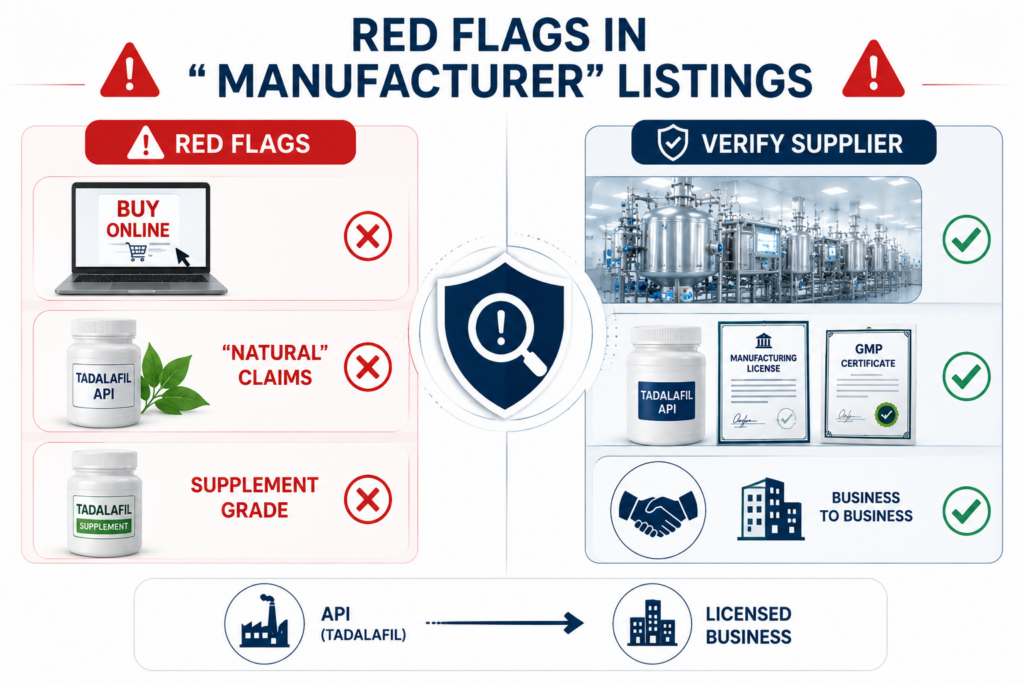
Some directory listings marketed toward this keyword use consumer-facing language such as “buy tadalafil online,” which has no place on a genuine API manufacturer’s page since API is sold to licensed businesses only. Be equally cautious of manufacturers claiming their Tadalafil API is a “natural” or supplement-grade product; Tadalafil is a synthetic, prescription-controlled active ingredient, and there is no FDA-recognized “natural” equivalent. A manufacturer’s page that cannot clearly separate itself from these claims warrants extra diligence before you proceed.
Vetting Checklist Before You Order
- Request the site’s FEI number and check FDA inspection history independently.
- Ask directly whether the company synthesizes on-site or sources from a third party, and get the actual production site’s address.
- Request a redacted batch manufacturing record and site master file.
- Confirm the DMF number is filed under the actual manufacturing site’s name, not a trading entity.
- Loop in your regulatory affairs team before referencing any DMF in your own filing.
When to See a Doctor (Finished Product Context)
This guide addresses manufacturer diligence for pharmaceutical businesses. Anyone taking a finished Tadalafil product who experiences an erection lasting more than four hours, sudden vision or hearing loss, chest pain, or signs of a severe allergic reaction should seek emergency medical care immediately. This is general safety information, not a substitute for professional medical advice.
Explore our detailed guide to Tadalafil API Manufacturers and Suppliers to learn how to identify reliable suppliers and evaluate quality, compliance, and sourcing requirements.
Read the full guide: Tadalafil API Manufacturers and Suppliers
Frequently Asked Questions
How do I know if a company is a real Tadalafil API manufacturer or a trader?
Ask for the production site address, its FEI number, and a GMP certificate issued in that site’s name rather than the trading entity’s. A manufacturer can name its own plant. A trader redirects documentation requests to an unnamed “partner facility” or supplies certificates where the company name and site address don’t match.
What documents should I request before placing a Tadalafil API order?
A site GMP certificate, the FEI number, a redacted batch manufacturing record, a site master file, a recent Certificate of Analysis with the impurity profile, and the DMF number if one is filed. Documents should carry consistent site names throughout. Mismatched names across a certificate set usually mean the paperwork was assembled by an intermediary.
Does my Indian Tadalafil API supplier need a US Drug Master File?
For a US ANDA, the API manufacturing site is referenced in your application, and a Type II DMF is the usual route for the manufacturer to submit its process and controls confidentially. Confirm the DMF is filed under the site that actually runs the synthesis. Your regulatory affairs team should verify the letter of authorization before you file.
What do FDA inspection classifications NAI, VAI and OAI mean for a supplier?
NAI means the inspection found no action indicated. VAI means observations were noted but the FDA is not pursuing action. OAI means significant issues remain unresolved, and buyers referencing that site in a filing take on the consequences. Look the classification up yourself using the FEI number rather than accepting a supplier’s summary of it.
Is a WHO-GMP certificate enough to import Tadalafil API into the US?
No. WHO-GMP reflects Indian licensing and export practice, not FDA clearance. US import turns on the site being acceptable under the application referencing it, plus correct import entry data. Treat WHO-GMP as a baseline that establishes the plant is licensed and inspected, then verify FDA status separately.
| Disclaimer: This article is for informational purposes only and is not a substitute for professional medical, legal, or regulatory advice. Consult your doctor before starting, stopping, or changing any medication, and consult qualified regulatory counsel before sourcing or importing any active pharmaceutical ingredient. |