
USDMF Tadalafil API Manufacturers: 2026 Buyer Guide
Direct answer
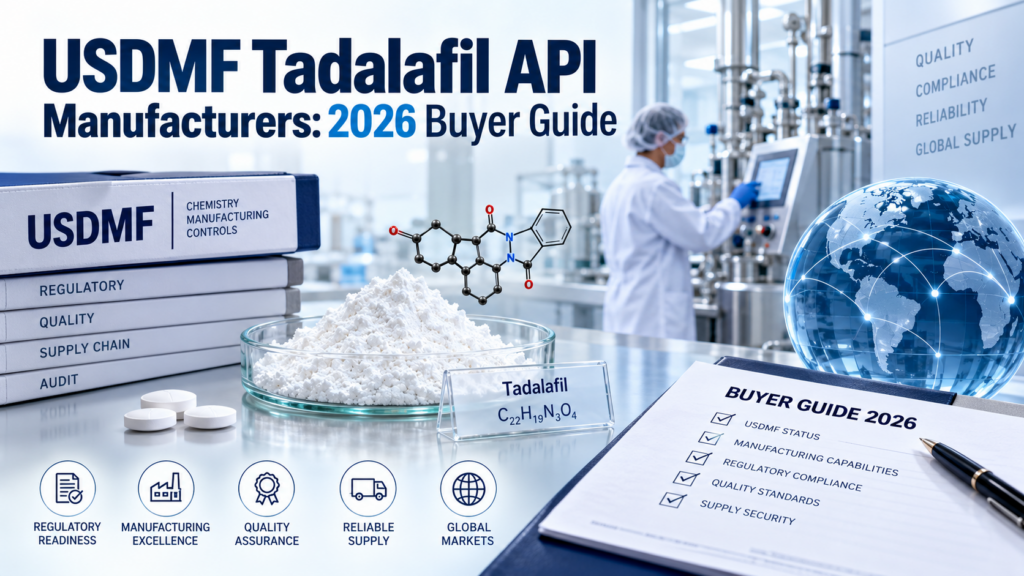
A USDMF tadalafil API manufacturer holds a Type II Drug Master File filed with the US FDA covering its tadalafil drug substance. FDA does not approve DMFs; it reviews them only when an ANDA or NDA references them under a Letter of Authorization. Buyers should verify the DMF number, holder name, site and “Available for Reference” status.
|
171596-29-5 Tadalafil CAS number (C22H19N3O4) |
Type II DMF category for a drug substance |
|
$102,584 FY 2026 GDUFA one-time DMF fee |
Quarterly Update cycle of the public FDA DMF list |
Search “USDMF tadalafil API manufacturers” and you will get directory pages listing dozens of company names, each with a small badge next to it. What almost none of those pages explain is what the badge actually certifies, who is allowed to hold one, and how a buyer confirms the claim is current. That gap matters, because a Drug Master File is a regulatory support document, not a quality award, and treating it as the latter is one of the most common sourcing errors in generic API procurement.
This guide is written for US-facing procurement, QA and regulatory affairs teams evaluating tadalafil drug substance. It covers what a USDMF proves, what it does not, and the specific checks to run before a purchase order.
What does USDMF mean for tadalafil API?
“USDMF” is industry shorthand for a Drug Master File submitted to the US Food and Drug Administration. For an active pharmaceutical ingredient such as tadalafil, the relevant category is a Type II DMF, which describes the drug substance: its synthetic route, manufacturing site, in-process controls, specification, impurity profile, container closure and stability data.
The file is confidential. It exists so an applicant, typically an ANDA sponsor filing a generic tadalafil tablet, can incorporate the API manufacturer’s proprietary chemistry into its own application without the API maker having to disclose that chemistry to the customer. The mechanism that connects the two is a Letter of Authorization (LOA), a written statement from the DMF holder permitting FDA to refer to the file in support of a specific application. [Source: FDA, Completeness Assessments for Type II API DMFs Under GDUFA, Guidance for Industry, Oct 2017]
DMFs must be submitted in eCTD format, and the holder is expected to file amendments when the process or site changes and to submit an annual report. A file that has gone years without an amendment or annual report is a question to raise, not a reassurance. [Source: FDA, Drug Master Files guidance]
Does a USDMF mean FDA approved the tadalafil API?
Common misconception
No. FDA states that Drug Master Files are neither approved nor disapproved, and are not required by statute or regulation. FDA reviews a DMF’s technical contents only in connection with an application that references it, such as an ANDA, NDA, IND or BLA. Any supplier describing itself as an “FDA approved tadalafil API manufacturer” on the strength of a DMF alone is describing something that does not exist. [Source: FDA, Drug Master Files (DMFs) guidance]
There is one meaningful status that comes close, and it is worth knowing precisely. Under GDUFA, a Type II API DMF referenced in a generic drug submission incurs a one-time user fee. Once that fee is paid and the file passes an initial Completeness Assessment, FDA places it on a publicly available list of DMFs available for reference. [Source: 21 U.S.C. 379j-42 (FD&C Act s.744B); FDA GDUFA guidance]
“Available for reference” confirms the file is administratively complete and the fee is settled. It is not a scientific endorsement of the chemistry, and it says nothing about whether the material in a given quotation was made at the site described in the file.
How many tadalafil API manufacturers hold a USDMF?
Tadalafil is a mature, post-patent molecule with a broad supplier base. Commercial API databases currently index roughly 130 or more tadalafil suppliers worldwide, of which a much smaller subset, in the region of 28, are associated with US Drug Master Files. Reported manufacturing geography is concentrated in India, followed by China, with a small European presence. [Source: PharmaCompass and Pharmaoffer API supplier databases, accessed 2026]
Treat those counts as directional only. Third-party databases aggregate self-reported listings and do not distinguish reliably between a manufacturer, a distributor and a trading company reselling someone else’s material. The authoritative source is FDA’s own DMF list, which is published and refreshed quarterly.
Why we do not publish a ranked list of holders. DMF status changes between quarterly publications, files are closed and transferred, and site scope can change without any visible signal to a buyer. A static list on a webpage goes stale quietly. The verification workflow below produces a current answer every time, which a list cannot.
USDMF vs CEP vs GMP certificate vs FDA registration
These four are routinely listed together in supplier profiles as if they were interchangeable credentials. They answer different questions, and only one of them is specific to a US filing.
| Document | Issued or received by | What it actually tells you |
|---|---|---|
| USDMF (Type II) | US FDA | Confidential CMC dossier exists on file and can be referenced by a US application under an LOA. Not an approval. |
| CEP / COS | EDQM (Europe) | The API has been assessed against the relevant European Pharmacopoeia monograph. Relevant to EU filings, not US ones. |
| GMP certificate | A national or regional inspectorate (WHO-GMP, state FDA, EU authority) | A named site passed an inspection against that authority’s standard, on a date, for a defined scope. Check issuer, scope and expiry. |
| FDA establishment registration | US FDA | The site has registered with FDA and listed its products. It is an administrative obligation, not a quality verdict. |
A supplier can hold a valid WHO-GMP certificate and a CEP and still have no active USDMF. If your finished product is destined for the United States, the CEP does not substitute.
How to verify a tadalafil USDMF claim in six steps
|
01
|
Ask for the DMF number and the holder’s legal name Not the trading name on the quotation. The DMF holder is the designated owner of the file and may be a different legal entity from the company emailing you. That is legitimate, but you need it in writing. |
|
02
|
Cross-check against FDA’s published DMF list FDA publishes the DMF list and updates it quarterly. Confirm the number, the holder name, the type (II) and the status. A number that does not appear, or appears under a different holder, ends the conversation until explained. |
|
03
|
Check the “available for reference” status If the file has passed a Completeness Assessment and the GDUFA fee is paid, it appears on FDA’s public list of DMFs available for reference. If it does not, ask whether a CA has been requested and who is paying the fee. |
|
04
|
Tie the file to the quoted site, route and grade This is the step most buyers skip. Confirm in writing that the material being quoted is made at the site, by the route, to the specification represented in the DMF. Second sites, alternate routes and toll manufacturers all break that link. |
|
05
|
Establish the Letter of Authorization process Ask who issues the LOA, in whose name, on what timeline, and whether it is conditional on volume or an exclusivity arrangement. You will not receive the restricted part of the file, and should not expect to, but you do need a workable LOA path. |
|
06
|
Confirm amendment and annual report currency Ask when the file was last amended and when the last annual report was filed. A dormant file attached to an active commercial process is a mismatch your QA team should resolve before qualification. |
What a complete tadalafil API document pack contains
Every document below should be tied to the exact material in the quotation, not to the company in general.
- API name, CAS number, grade (USP, BP, EP or in-house), specification and intended use
- Manufacturer legal name, manufacturing site address, and the seller’s relationship to that site
- Current GMP evidence: issuing authority, scope, issue date, expiry, site address
- DMF or USDMF reference with holder name, type and filing status, plus the LOA process
- Batch-specific Certificate of Analysis, plus a representative sample CoA
- Safety Data Sheet, retest date, storage conditions and container closure description
- Impurity profile, residual solvents, heavy metals, water content or loss on drying, with validated method references
- Elemental impurity and nitrosamine risk assessment position, where applicable to your filing
- Export documentation set: certificate of origin, packing list, and any market-specific attestations
Red flags in tadalafil USDMF claims
Escalate to QA or RA before proceeding
- The phrase “FDA approved API” or “FDA approved manufacturer” used to describe a DMF
- A DMF badge with no number, or a number the supplier will not put in writing
- A holder name that does not match the entity issuing the invoice, with no explanation of the relationship
- Refusal to confirm the manufacturing site address, or an address that is an office rather than a plant
- An LOA promised only after payment or only after a minimum order quantity
- Pricing far below the market range for a documented, USDMF-backed source
- Marketplace listings that mix API, intermediates and finished tablets under one profile without distinguishing them
What a USDMF costs the manufacturer, and why it shows up in your price
Maintaining US regulatory support is a real cost line for an API maker, and it is part of why a documented source prices differently from an undocumented one. Current published GDUFA III rates:
| Fee | FY 2026 | FY 2027 |
|---|---|---|
| Type II API DMF (one-time) | $102,584 | $109,899 |
| API facility, US (annual) | $43,549 | See current FR notice |
| API facility, non-US (annual) | $58,549 | See current FR notice |
FY 2026 rates were effective 1 October 2025 through 30 September 2026. The FY 2027 DMF fee applies from 1 October 2026. Verify current amounts against the Federal Register notice before budgeting. [Source: Federal Register, Generic Drug User Fee Rates for FY 2026 and FY 2027]

Clinical context: what the API becomes
Tadalafil is a phosphodiesterase type 5 (PDE5) inhibitor. In the United States it is approved in finished dosage form for erectile dysfunction, the signs and symptoms of benign prostatic hyperplasia, and pulmonary arterial hypertension, marketed under the brand names Cialis and Adcirca and as generics. [Source: FDA Prescribing Information, Cialis and Adcirca]
Buyers qualifying an API source do not prescribe, but the safety profile of the finished product is what drives the impurity, content-uniformity and stability expectations placed on the drug substance. It is worth knowing what the molecule carries.
| Approved US indication | Typical dosing pattern | Common tablet strengths |
|---|---|---|
| Erectile dysfunction | As-needed or once daily, per the approved labeling | 2.5, 5, 10, 20 mg |
| Benign prostatic hyperplasia | Once daily, per the approved labeling | 5 mg |
| Pulmonary arterial hypertension | Once daily, per the approved labeling | 20 mg |
Strengths and regimens shown for orientation only, taken from the approved US labeling. Dosing decisions belong to a prescribing clinician. [Source: FDA Prescribing Information, Cialis and Adcirca]
Who should not take tadalafil
- Anyone taking organic nitrates in any form, regularly or intermittently. Co-administration can cause a serious drop in blood pressure and is contraindicated.
- Anyone with known hypersensitivity to tadalafil or any component of the formulation.
- Caution applies with alpha-blockers and other antihypertensives because of additive blood-pressure effects, and in patients for whom sexual activity is inadvisable on cardiovascular grounds.
Labeled warnings include prolonged erection and priapism, sudden decrease or loss of vision associated with non-arteritic anterior ischemic optic neuropathy, and sudden decrease or loss of hearing. The product carries no boxed warning. [Source: FDA Prescribing Information, Cialis]
When to see a doctor
Anyone taking tadalafil who experiences an erection lasting more than four hours, sudden vision or hearing changes, chest pain, fainting, or symptoms of an allergic reaction should seek medical attention promptly. Tadalafil is a prescription medicine in the United States and should be taken only under the supervision of a licensed clinician.
A note on unapproved products. Tadalafil sold without a prescription, through unlicensed online channels, or as a “natural” or herbal supplement is outside the regulated supply chain. Products marketed as botanical or dietary supplements have repeatedly been found to contain undeclared PDE5 inhibitors, which carries a real interaction risk for anyone taking nitrates and no assurance of identity, strength or purity. This site supplies pharmaceutical-grade API to qualified business buyers only and does not sell to individuals or supply finished medicines to consumers.
Frequently asked questions
Does a USDMF mean the FDA approved the tadalafil API?
No. FDA neither approves nor disapproves Drug Master Files. The file’s technical content is reviewed only when an application such as an ANDA or NDA references it. A DMF supports a filing; it is not a product approval or a quality certification.
How do I check whether a tadalafil DMF is active?
Get the DMF number and holder name in writing, then cross-check both against FDA’s published DMF list, which is updated quarterly, and against the list of DMFs available for reference. Then confirm separately that the quoted material comes from the site and route described in that file.
Can a trading company hold a tadalafil USDMF?
A Type II API DMF describes a specific manufacturing process at a specific site, so the holder is normally the manufacturer. A distributor or exporter can arrange access to a manufacturer’s file through a Letter of Authorization, but that is a different relationship. Ask directly which one you are dealing with.
Is a CEP an acceptable substitute for a USDMF in a US filing?
No. A CEP is issued by EDQM and supports European filings. A US application needs US-appropriate CMC support, typically a Type II DMF referenced under an LOA. Many tadalafil API makers hold both, but they are not interchangeable.
Safety: why does the nitrate contraindication matter to an API buyer?
Because it defines the seriousness of the finished product. Tadalafil is contraindicated with organic nitrates due to the risk of a serious drop in blood pressure, which is one reason the molecule is prescription-only and why identity, strength and impurity control at the API stage are not paperwork exercises. It is also why undeclared tadalafil in “natural” supplements is a genuine public health problem rather than a labeling technicality. [Source: FDA Prescribing Information, Cialis]
Sources
- US FDA. Drug Master Files (DMFs). Guidance and public DMF list.
- US FDA. Completeness Assessments for Type II API DMFs Under GDUFA, Guidance for Industry, October 2017.
- Federal Food, Drug, and Cosmetic Act, section 744B (Generic Drug User Fee Amendments).
- Federal Register. Generic Drug User Fee Rates for Fiscal Year 2026, 30 July 2025.
- Federal Register. Generic Drug User Fee Rates for Fiscal Year 2027, 30 July 2026.
- US FDA. Prescribing Information, Cialis (tadalafil) tablets.
- US FDA. Prescribing Information, Adcirca (tadalafil) tablets.
- PubChem. Tadalafil, CID 110635.
This article is for informational purposes only and is not a substitute for professional medical advice. Consult your doctor before starting, stopping, or changing any medication. Regulatory information is provided for general guidance and does not constitute regulatory or legal advice. Verify all filing requirements and fee amounts against current FDA sources before acting.
B2B supply only. We do not sell prescription medicines to individuals.