
Adverse Effects Of Tadalafil: A Practical Guide
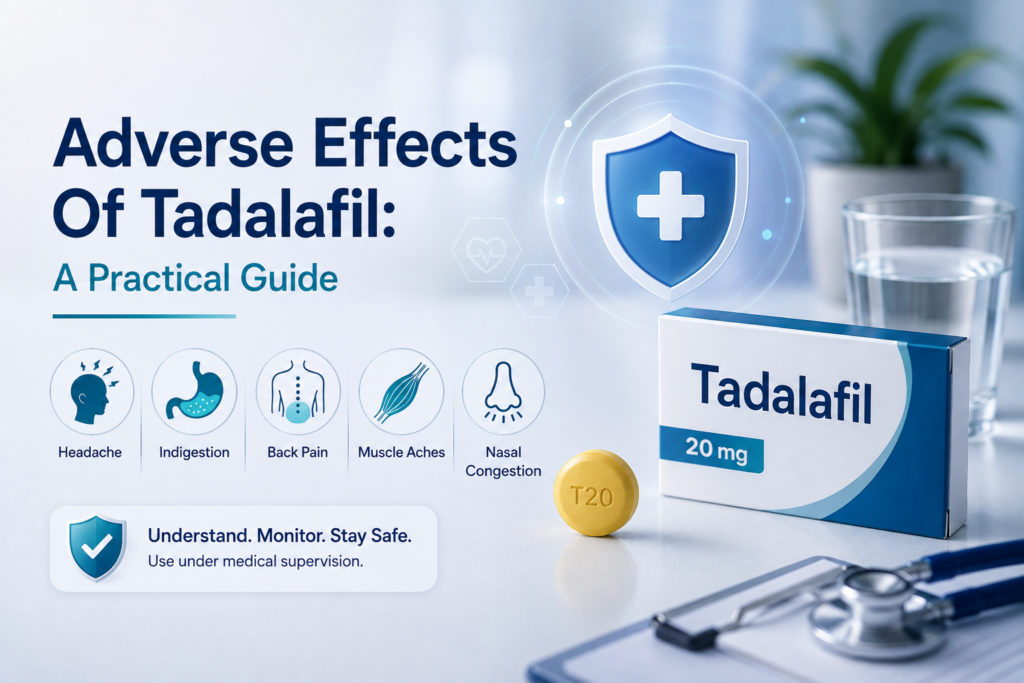
“Adverse effects of tadalafil” covers a range of related questions: what actually happens in the body, how the drug’s half-life shapes those effects, what the real benefits are, and how a starting dose gets chosen. This guide walks through each with the underlying data.
|
Quick Answer Tadalafil’s most common adverse effects are headache, dyspepsia, back pain, muscle aches, flushing, and nasal congestion, all dose-dependent and generally mild. Rare but serious effects include priapism and sudden vision or hearing loss. Its 17.5-hour half-life supports up to 36 hours of effect, and dosing (2.5 mg to 20 mg) should be individualized by a prescriber based on condition, response, and tolerability. [Source: FDA Tadalafil Prescribing Information] |
Common Adverse Effects of Tadalafil
| Adverse Effect | Category |
| Headache | Very common [Source: FDA Tadalafil Prescribing Information] |
| Dyspepsia, nausea | Very common (up to 13%) [Source: FDA Tadalafil Prescribing Information] |
| Back pain, myalgia | Common, dose-dependent [Source: FDA Tadalafil Prescribing Information] |
| Flushing, nasal congestion | Common [Source: FDA Tadalafil Prescribing Information] |
| Dizziness | Common [Source: FDA Tadalafil Prescribing Information] |
Serious but Rare Adverse Effects
|
Seek Urgent Medical Attention For Priapism: an erection lasting longer than 4 hours can cause permanent damage if untreated. [Source: FDA Tadalafil Prescribing Information] Sudden decreased or lost vision, possibly indicating non-arteritic anterior ischemic optic neuropathy (NAION). [Source: FDA Tadalafil Prescribing Information] Sudden decreased or lost hearing, sometimes with ringing in the ears or dizziness. [Source: FDA Tadalafil Prescribing Information] |
Postmarketing surveillance has also noted reports of myocardial infarction, stroke, and sudden cardiac death occurring in temporal association with tadalafil use, most often in patients with pre-existing cardiovascular risk factors. Pooled clinical trial data has not shown these events occurring at a higher rate than placebo. [Source: FDA Tadalafil Prescribing Information; Kloner et al., 2003]

Half-Life of Tadalafil: Why It Matters
Tadalafil has an elimination half-life of approximately 17.5 hours in healthy subjects, meaning it takes about that long for half the drug to clear the bloodstream. This is substantially longer than sildenafil’s roughly 4-hour half-life. [Source: FDA Tadalafil Prescribing Information]
That long half-life is the reason tadalafil’s effects extend to about 36 hours after a single as-needed dose, and it’s also why the nitrate-interaction waiting period after a dose is set at 48 hours, not just a few hours. [Source: FDA Tadalafil Prescribing Information]
Benefits of Tadalafil
When appropriately prescribed, tadalafil can improve erectile-function outcomes in men with ED; the AUA guideline identifies FDA-approved oral PDE5 inhibitors as an evidence-based treatment option. [Source: AUA Erectile Dysfunction Guideline]
For BPH, tadalafil 5 mg once daily is used to relieve urinary symptoms from an enlarged prostate, and is also approved for men who have both BPH and ED. [Source: FDA Tadalafil Prescribing Information]
A large retrospective claims-database cohort study found tadalafil use associated with lower rates of major adverse cardiovascular events and all-cause mortality in men with ED, though this is observational data reflecting association, not a randomized trial proving tadalafil prevents these events. [Source: retrospective cohort study, PMC, 2024]
How Many mg of Tadalafil Should You Take?
Tadalafil is available in several FDA-approved strengths, and the right one depends on the condition being treated, individual response, and tolerability, not a fixed number that applies to everyone:
| Use | Typical FDA-Labeled Range |
| ED, as-needed | Starting 10 mg, adjustable to 5-20 mg [Source: FDA Tadalafil Prescribing Information] |
| ED, once daily | 2.5 mg, adjustable to 5 mg [Source: FDA Tadalafil Prescribing Information] |
| BPH | 5 mg once daily [Source: FDA Tadalafil Prescribing Information] |
| PAH (Adcirca) | 40 mg once daily [Source: FDA Tadalafil Prescribing Information] |
Reduced starting doses apply for hepatic impairment, significant renal impairment, and concurrent use with certain CYP3A4 inhibitors. This is exactly the kind of decision that belongs to a prescriber reviewing individual health history, not a self-selected dose. [Source: FDA Tadalafil Prescribing Information]
Who Should Not Take Tadalafil
|
Contraindications and Cautions Contraindicated with organic nitrates and guanylate cyclase stimulators such as riociguat. [Source: FDA Tadalafil Prescribing Information] Use caution with alpha-blockers, other antihypertensives, and unstable cardiovascular disease. Anyone with priapism-predisposing conditions or a history of sudden vision or hearing loss on a PDE5 inhibitor should discuss risk with a prescriber first. |
Do Higher Doses Mean More Adverse Effects?
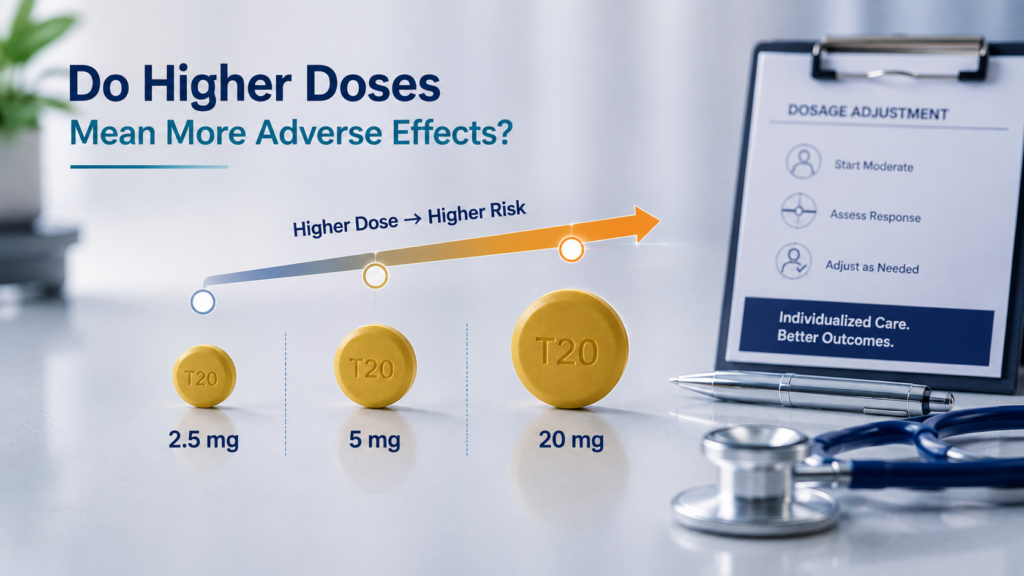
Adverse effects are dose-dependent, so the 20 mg dose carries a higher likelihood of noticeable effects than 2.5 mg or 5 mg. This is why prescribers typically start at a moderate dose and adjust based on response and tolerability rather than starting at the maximum. [Source: FDA Tadalafil Prescribing Information]
Warning Signs of an Unverified Tadalafil Product
| Sold without a prescription requirement |
| Marketed as “natural tadalafil” or a supplement with no listed strength |
| Unusually severe or unfamiliar adverse effects inconsistent with known safety data, which can signal counterfeit or mis-dosed product |
When Should You See a Doctor?
| You’re unsure what starting dose or dosing schedule fits your situation |
| You have cardiovascular disease, reduced kidney or liver function, or take multiple medications |
| Adverse effects are severe, persistent, or worsening |
| You experience an erection lasting more than 4 hours, or sudden vision or hearing changes |
Frequently Asked Questions
What are the adverse effects of tadalafil?
Most commonly headache, dyspepsia, back pain, muscle aches, flushing, and nasal congestion. Rare but serious effects include priapism and sudden vision or hearing loss.
What is the half-life of tadalafil?
Approximately 17.5 hours in healthy subjects, which is why its effects can last up to 36 hours after a single as-needed dose.
What are the benefits of taking tadalafil?
For ED, it improves erectile function outcomes; for BPH, it relieves urinary symptoms from an enlarged prostate. It’s also approved for pulmonary arterial hypertension.
How many mg of tadalafil should I take?
This depends on the condition and individual factors. FDA-labeled doses range from 2.5 mg to 40 mg depending on use, but the specific starting dose should be determined by a prescriber, not chosen independently.
Is it dangerous to combine tadalafil with nitrates?
Yes. Tadalafil is contraindicated with nitrates because the combination can cause a severe, potentially life-threatening drop in blood pressure.
|
The Bottom Line Tadalafil’s adverse effects are generally mild, dose-dependent, and predictable from its vasodilatory mechanism, with rare but serious risks like priapism and sudden vision or hearing loss requiring urgent attention. Its long half-life supports extended effectiveness but also means interaction precautions, like the nitrate waiting period, need to account for that extended window. Dosing decisions belong with a prescriber weighing individual health factors. |
This article is for informational purposes only and is not a substitute for professional medical advice. Consult your doctor before starting, stopping, or changing any medication.
|
References and Sources FDA. Tadalafil (Cialis/Adcirca) Prescribing Information. American Urological Association. Erectile Dysfunction Guideline. Kloner RA, et al. Cardiovascular Effects of Tadalafil. American Journal of Cardiology, 2003. Retrospective cohort study on tadalafil exposure and cardiovascular outcomes in men with ED. PMC, 2024. |