
WHO-GMP Tadalafil API Manufacturers and Suppliers: A Sourcing Guide for US Buyers
Most tadalafil API sourcing decisions go wrong at the same point. A buyer receives a clean WHO-GMP certificate, a Certificate of Analysis showing 99.7 percent purity, and a competitive price per kilogram, and treats that package as sufficient evidence for a US filing. It is not. WHO-GMP and US cGMP are different frameworks issued by different authorities for different purposes, and the FDA assesses only one when it reviews an abbreviated new drug application.
This guide sets out what the WHO-GMP designation actually covers, what a US buyer needs on top of it, and which documents to request before a purchase order is issued. It is written for formulation, quality, and procurement teams, not for patients.
What does “WHO-GMP tadalafil API” actually mean?
WHO-GMP refers to the good manufacturing practice standard described in WHO Technical Report Series 986, Annex 2. It is an international reference framework. The World Health Organization does not itself inspect factories or issue certificates to individual companies. National regulators do that, and they issue the certificate under the WHO certification scheme.
In India, that means a State Licensing Authority or CDSCO inspects the site and issues a WHO-GMP certificate, usually alongside a Certificate of Pharmaceutical Product (COPP). Both documents are named for a specific site and a specific product list. A WHO-GMP certificate that covers a different product, or a different block at the same address, does not cover your tadalafil API.
WHO-GMP versus India’s revised Schedule M
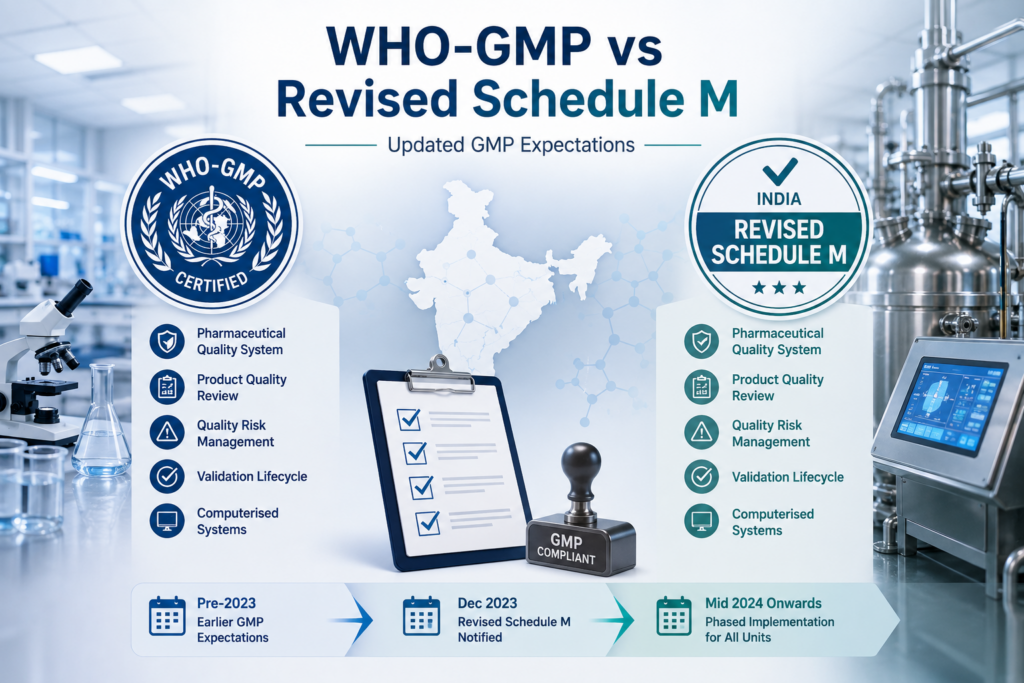
Schedule M of the Drugs and Cosmetics Rules is India’s domestic statutory GMP requirement. The revised Schedule M, notified in December 2023, moved Indian GMP substantially closer to WHO-GMP by adding formal pharmaceutical quality system, product quality review, quality risk management, validation lifecycle and computerised systems requirements. Large manufacturers came into scope from mid-2024, with a phased extension for smaller units.
The practical consequence for buyers: a site that was WHO-GMP certified before this transition may have been recertified under materially different expectations since. Ask for the certificate issue date and the most recent inspection date, not just the certificate.
WHO-GMP versus US cGMP, and why the difference matters
Common misconception
The FDA does not “approve” an API on its own, and it does not recognise a WHO-GMP certificate as evidence of US cGMP compliance. An API becomes usable in a US-marketed drug product only through an approved application (NDA or ANDA) for the finished product, which references the API’s manufacturing data. Supplier directories that describe an API as “FDA approved” are using the term loosely.
For US supply, the operative GMP expectation for an API manufacturer is ICH Q7, adopted by the FDA as guidance for industry. A site can hold a valid WHO-GMP certificate and still not be ready for an FDA pre-approval inspection. Treat the two as separate qualification tracks that happen to overlap.
What US buyers must verify beyond the WHO-GMP certificate
1. An active US Type II DMF, available for reference. A Type II Drug Master File covers the API and its intermediates. Filing one is voluntary, and a DMF is never itself approved or rejected. Its contents are assessed only when an application references it. Under GDUFA, a Type II API DMF must have paid its fee and passed a completeness assessment before an ANDA can reference it. If it has not, the FDA will refuse to receive the referencing ANDA. Ask the supplier for the DMF number and confirm it appears on the FDA’s published list of Type II DMFs available for reference. [Source: FDA, Types of Drug Master Files; FDA, Completeness Assessments for Type II API DMFs Under GDUFA]
2. A Letter of Authorization. The DMF holder must issue an LoA naming your application before the FDA will look at the file on your behalf. Confirm the supplier will issue one, in writing, before you commit.
3. FDA establishment registration. Foreign sites shipping drug substance to the US register with the FDA and receive an FEI number. Ask for it and verify the registered address matches the manufacturing address on the CoA, not the trading office address.
4. Inspection history. Request the date and outcome of the last regulatory inspection, and ask directly whether the site has received an FDA Form 483 or warning letter. A supplier that declines to answer has told you something.
5. Patent and freedom-to-operate position. Tadalafil’s principal US patents have expired and generic competition is active, but formulation, polymorph and use patents can persist independently of the compound patent. Several API directories carry a standing note that patented products are offered for research and development purposes only. Verify your own position; do not rely on a supplier’s disclaimer.
Which documents should you request before ordering?
Send this list as a single request at first contact. Response speed and completeness are themselves a qualification signal.
| Document | What it tells you | Priority |
|---|---|---|
| Certificate of Analysis (batch specific) | Assay, related substances, residual solvents, water content, heavy metals, against a stated pharmacopeial monograph | Essential |
| WHO-GMP certificate and COPP | Site and product scope, issuing authority, validity dates | Essential |
| US Type II DMF number and LoA commitment | Whether the API can support a US ANDA at all | Essential for US |
| CEP / COS | EDQM assessment against the European Pharmacopoeia monograph, relevant for EU-bound supply | Market dependent |
| Stability data (ICH Q1A) | Retest period, storage conditions, degradation profile in your climatic zone | Essential |
| Impurity profile and method validation | Identified, unidentified and total impurities; whether analytical methods are validated to ICH Q2 | Essential |
| Nitrosamine risk assessment | Whether the route of synthesis has been assessed for nitrosamine formation | Increasingly expected |
| MSDS, BSE/TSE and elemental impurity statements | Handling, animal-origin freedom, ICH Q3D position | Standard |
Manufacturer, supplier, exporter or distributor?
B2B marketplaces routinely list these four roles under a single “supplier” label, and the distinction is the one buyers most often skip. The party selling the material may not be the party that manufactured, released, registered or exported it.
| Role | What they control | The question to ask |
|---|---|---|
| API manufacturer | Route of synthesis, GMP site, batch release, DMF holding | Do you hold the DMF, or does someone else? |
| Exporter | Shipping documentation, customs, export licensing | Which manufacturing site appears on the CoA? |
| Distributor / trader | Stock, repacking, onward sale | Has this material been repacked, and under whose GMP? |
| Intermediate supplier | Upstream starting materials, not the finished API | At which step does GMP coverage begin? |
Repacking is the quiet risk. If a trader has resized drums, the chain of custody and the original manufacturer’s retest period may both be compromised. Publicly available listings show tadalafil API production concentrated in India, China and Poland, with both the originator and multiple secondary packagers present in the market, which makes supply-chain traceability a live question rather than a formality.
Tadalafil API specification attributes worth scrutinising
Tadalafil is a poorly water-soluble compound, so attributes that would be secondary for a freely soluble API become primary here.
- Pharmacopeial grade. Confirm whether the CoA is written against USP, Ph. Eur. or an in-house monograph. “Tadalafil USP” and “tadalafil BP” are not interchangeable claims, and an in-house monograph is not a pharmacopeial one.
- Polymorphic form. Solid-state form influences dissolution behaviour for low-solubility compounds. Ask which form is supplied, how it is confirmed (XRPD is the usual method), and whether form is a released specification or merely characterised.
- Particle size distribution. If your formulation relies on micronised material, PSD needs to be a specification with stated limits, not a typical value on a datasheet.
- Residual solvents. Check the classes present against ICH Q3C limits, and check them against the actual route of synthesis rather than a generic statement.
- Batch-to-batch consistency. One CoA is a snapshot. Request three consecutive batches and compare the impurity profile across them.

Practical tip: ask for the three CoAs before you ask for the price. Suppliers who can produce them same-day are operating a real quality system. Suppliers who send a single undated PDF with the batch number removed are usually reselling.
Why API quality carries clinical consequences
Tadalafil is a selective phosphodiesterase type 5 inhibitor. In the United States it is approved under the Cialis label for erectile dysfunction, for the signs and symptoms of benign prostatic hyperplasia, and for the two conditions when they occur together. Under a separate label it is approved for pulmonary arterial hypertension, WHO Group 1, to improve exercise ability. [Source: FDA, CIALIS Prescribing Information; DailyMed, Tadalafil tablets label]
This is a prescription-only medicine with a defined haemodynamic interaction profile. Content uniformity and dissolution performance in the finished tablet are what deliver a predictable exposure, and both trace back to API attributes. That is the connection between a specification sheet and a patient outcome.
Who should not take tadalafil: label contraindications and key warnings
- Nitrates. Administration to patients using any form of organic nitrate, regularly or intermittently, is contraindicated. Tadalafil potentiates the hypotensive effect of nitrates. Where nitrate administration is deemed medically necessary in a life-threatening situation, the label states that at least 48 hours should elapse after the last dose, and that nitrates should still only be given under close medical supervision with hemodynamic monitoring. [Source: FDA, CIALIS Prescribing Information, sections 4.1 and 12.2]
- Guanylate cyclase stimulators. Concomitant use with GC stimulators such as riociguat is contraindicated. [Source: DailyMed, Tadalafil tablets label]
- Known serious hypersensitivity to tadalafil. Hypersensitivity reactions including Stevens-Johnson syndrome and exfoliative dermatitis have been reported. [Source: FDA, CIALIS Prescribing Information, section 4.2]
- Alpha-blockers. The label advises caution when PDE5 inhibitors are coadministered with alpha-blockers, because of the potential for symptomatic hypotension. [Source: FDA, CIALIS Prescribing Information, section 7]
- Cardiovascular considerations. Patients with left ventricular outflow obstruction, such as aortic stenosis, can be sensitive to vasodilators. Several cardiovascular subgroups were excluded from the clinical trials, and the label sets out where use is not recommended. [Source: FDA, CIALIS Prescribing Information, section 5]
- Hepatic impairment. In severe hepatic impairment (Child-Pugh Class C), use is not recommended. [Source: FDA, CIALIS Prescribing Information, section 8.6]
- Potent CYP3A4 inhibitors. With drugs such as ketoconazole or ritonavir, the label limits the once-daily dose. [Source: FDA, CIALIS Prescribing Information, section 7.2]
- Priapism, NAION and sudden hearing loss. The label directs patients to seek immediate medical attention for an erection lasting more than four hours, and for sudden loss of vision in one or both eyes, which may signal non-arteritic anterior ischemic optic neuropathy. Risk of NAION is increased in individuals who have already experienced it in one eye. [Source: DailyMed, Tadalafil tablets label, section 17]
Tadalafil does not carry an FDA boxed warning. This summary is condensed and is not a substitute for the full prescribing information. Prescribing and dosing decisions belong to a qualified healthcare professional.
Approved uses and label strengths at a glance
| Approved use | US label strengths | Dosing pattern on the label | Reference brand |
|---|---|---|---|
| Erectile dysfunction | 2.5, 5, 10 and 20 mg film-coated tablets | Use as needed, or once daily at lower strengths | Cialis |
| Benign prostatic hyperplasia | Lower strengths from the same range | Once daily | Cialis |
| ED and BPH together | Lower strengths from the same range | Once daily | Cialis |
| Pulmonary arterial hypertension (WHO Group 1) | 20 mg tablets | Once daily, per the PAH label | Adcirca |
Table summarises approved indications and available strengths for formulation planning. It is not dosing guidance. Confirm every value against the current FDA-approved labelling before use. [Source: FDA, CIALIS Prescribing Information; DailyMed, Tadalafil tablets label]
On pharmacokinetics, the label reports a mean terminal half-life of approximately 17.5 hours in healthy subjects, which underlies the longer dosing interval associated with tadalafil compared with some other PDE5 inhibitors. Comparative statements about clinical superiority between PDE5 inhibitors require head-to-head trial evidence and should not be inferred from half-life alone. [Source: FDA, CIALIS Prescribing Information, section 12.3]
Counterfeit material and adulterated supplements
Two distinct risks
Counterfeit and unregulated online sales. Tadalafil sold without a prescription through unverified online channels carries no assurance of identity, strength, purity or manufacturing origin. Material of unknown provenance should never enter a regulated supply chain, and patients should obtain the medicine only through a licensed pharmacy against a valid prescription.
“Natural tadalafil” supplement claims. There is no naturally occurring tadalafil. Products marketed as natural or herbal sexual-enhancement supplements have repeatedly been found by regulators to contain undeclared PDE5 inhibitors. Because these are undeclared, a consumer taking nitrates has no way to know they are exposed to a contraindicated interaction. Any marketing claim of a natural equivalent to tadalafil should be treated as a red flag.
For buyers, the procurement-side control is documentary. Insist on a manufacturing site named on the CoA, an FEI number that resolves to that site, and shipping documents that trace continuously from that site to your dock.
When to see a doctor
This page is written for procurement and quality professionals, but if you have arrived here as a patient or carer, the following situations warrant prompt medical attention while taking tadalafil:
- Chest pain or anginal symptoms after taking the medicine. Do not take nitrates to relieve it. Seek emergency care and tell the clinician you have taken tadalafil.
- An erection lasting more than four hours.
- Sudden loss or decrease of vision, in one or both eyes.
- Sudden decrease or loss of hearing, with or without ringing in the ears or dizziness.
- Any rash, blistering or peeling of the skin.
Tell your prescriber about every medicine you take, particularly nitrates, alpha-blockers, riociguat, and antifungal or antiretroviral medicines. [Source: FDA, CIALIS Prescribing Information; DailyMed, Tadalafil tablets label]
Frequently asked questions
Is WHO-GMP certification the same as US FDA approval?
No. WHO-GMP is a GMP standard certified by a national regulator under the WHO certification scheme. The FDA does not issue approvals for APIs in isolation and does not treat a WHO-GMP certificate as evidence of US cGMP compliance. For US supply the relevant GMP reference is ICH Q7, and the regulatory route runs through an approved NDA or ANDA for the finished product.
Do I need a Drug Master File to use tadalafil API in the United States?
Filing a DMF is voluntary and it is not itself approved or rejected. In practice it is how most API manufacturers support a customer’s ANDA without disclosing proprietary process detail. Under GDUFA, a Type II API DMF must have paid its fee and passed a completeness assessment before an ANDA can reference it, and an application referencing a DMF that is not available for reference will not be received. [Source: FDA, Types of Drug Master Files; FDA, Completeness Assessments for Type II API DMFs Under GDUFA]
Can tadalafil be taken with nitrates?
No. The FDA label states that administration to patients using any form of organic nitrate, regularly or intermittently, is contraindicated, because tadalafil potentiates the hypotensive effect of nitrates. Where nitrate administration is deemed medically necessary in a life-threatening situation, the label indicates that at least 48 hours should elapse after the last tadalafil dose, and that nitrates should still be given only under close medical supervision with hemodynamic monitoring. Patients who experience anginal chest pain after taking tadalafil should seek immediate medical attention. [Source: FDA, CIALIS Prescribing Information, sections 4.1 and 12.2]
Which countries manufacture tadalafil API?
Publicly listed production is concentrated in India, with additional producers reported in China and Poland, and further supply routed through European and North American distributors. Manufacturing geography matters for lead time, freight and inspection history, so establish the actual site rather than the seller’s country of incorporation.
What is the difference between tadalafil USP and tadalafil EP grade?
They reference different pharmacopeial monographs, the United States Pharmacopeia and the European Pharmacopoeia, which can differ in tests, acceptance criteria and named impurities. Specify the monograph your filing requires in the purchase specification, and confirm the CoA is written against that monograph rather than an in-house method.
Are “natural tadalafil” supplements a legitimate alternative?
No. Tadalafil is a synthetic compound and does not occur naturally. Products marketed as natural sexual-enhancement supplements have repeatedly been found to contain undeclared PDE5 inhibitors, which places anyone taking nitrates at risk of a contraindicated interaction they do not know about.
Disclaimer: This article is for informational purposes only and is not a substitute for professional medical advice. Consult your doctor before starting, stopping, or changing any medication. Regulatory information is provided for general guidance and does not constitute regulatory or legal advice. Verify all requirements against current FDA, EMA and CDSCO sources before making a sourcing or filing decision.
References
- US Food and Drug Administration. CIALIS (tadalafil) tablets, full prescribing information. accessdata.fda.gov
- DailyMed, US National Library of Medicine. Tadalafil tablet, film coated, label. dailymed.nlm.nih.gov
- US Food and Drug Administration. Types of Drug Master Files (DMFs). fda.gov
- US Food and Drug Administration. Completeness Assessments for Type II API DMFs Under GDUFA, guidance for industry. fda.gov
- US Food and Drug Administration. Drug Master Files, guidance for industry. fda.gov
- Srinivasan A, Iser J, Gill R. Completeness assessment of Type II API drug master files under GDUFA. PMC4147054
- World Health Organization. WHO Technical Report Series 986, Annex 2: WHO good manufacturing practices for pharmaceutical products. [ADD VERIFIED URL BEFORE PUBLISHING]
- Central Drugs Standard Control Organisation, India. Revised Schedule M, Drugs and Cosmetics Rules 1945. [ADD VERIFIED URL BEFORE PUBLISHING]
- American Urological Association. Erectile Dysfunction: AUA Guideline. [ADD VERIFIED URL AND ACCESS DATE BEFORE PUBLISHING]